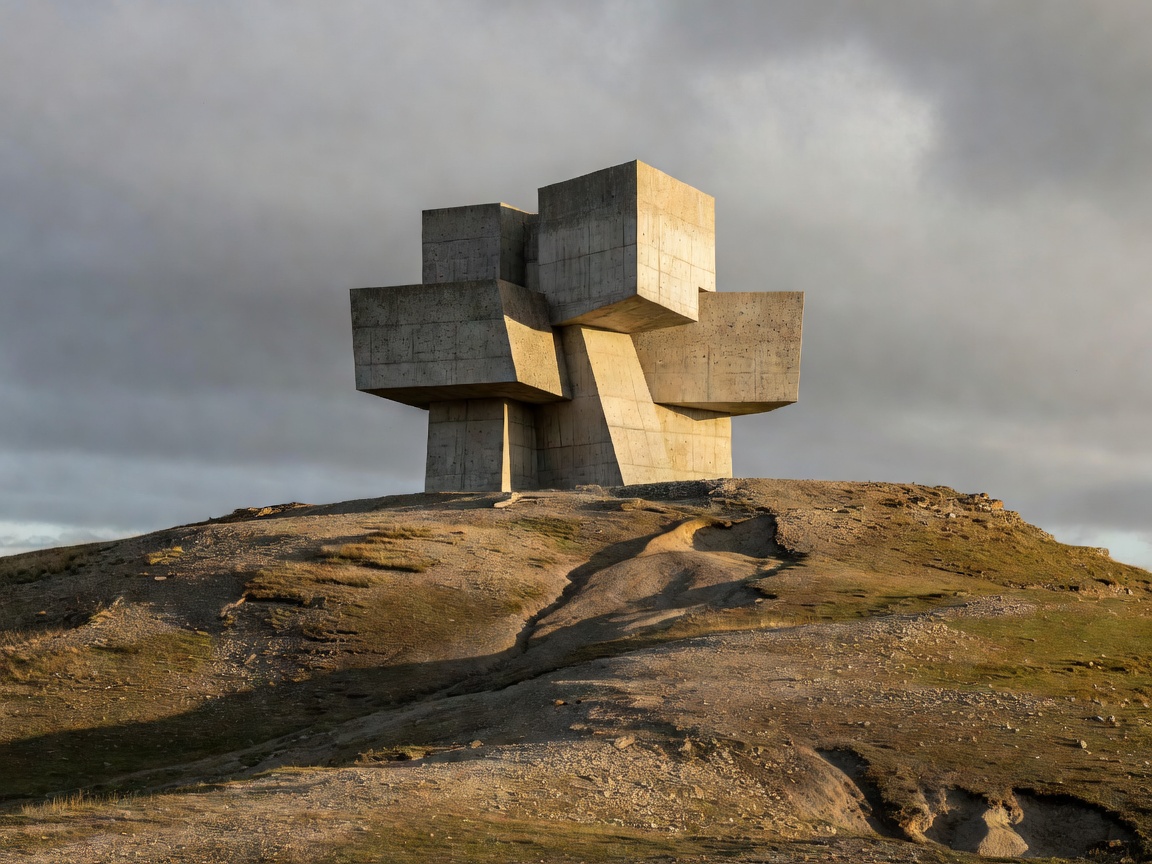
Across the remote mountain ranges of the former Yugoslavia and the high plateaus of the Caucasus stands a distributed constellation of architectural apparitions. Neither classical memorial statues nor conventional civic infrastructure, these concrete megaliths—known in the Balkans as *spomeniks*—look less like terrestrial buildings and more like starships that crash-landed during the Cold War Space Race.
Breaking Free from Socialist Realism
Following Josip Broz Tito’s split with Stalin in 1948, Yugoslavia consciously rejected the rigid, neoclassical Socialist Realism imposed by Moscow. Instead, the state commissioned visionary sculptors and architects—such as Bogdan Bogdanović, Dušan Džamonja, and Miodrag Živković—to design hundreds of abstract, non-figurative monuments to commemorate WWII resistance and unity.
"We did not want figures holding rifles or grieving mothers in bronze. We sought cosmic geometries that looked 500 years into the future."
The Engineering of Cantilevered Concrete Wings
The monument at Tjentište (The Valley of Heroes), completed in 1971, consists of two massive fractured concrete wings that soar 19 meters into the Bosnian sky. The structural engineer devised intricate internal steel rebar trusses that allow the concrete slabs to cantilever over empty space without vertical pillar support, evoking the sudden eruption of a geological fault line.
Similarly, the Buzludzha Monument in Bulgaria—built on a desolate 1,441-meter peak—resembles an immense concrete flying saucer anchored to a 70-meter tower, crowned with ruby-glass stars. Its 42-meter diameter dome required 70,000 tons of concrete and hundreds of tons of structural steel to withstand fierce sub-zero Balkan winter blizzards.
The Modern Resonance of Brutalist Relics
Today, these strange structures have shifted from ideological propaganda tools to global shrines of speculative futurism. Their radical abstraction, texture, and uncompromising scale serve as proof that monumental civic design can escape sentimental historicism to reach something genuinely transcendental.