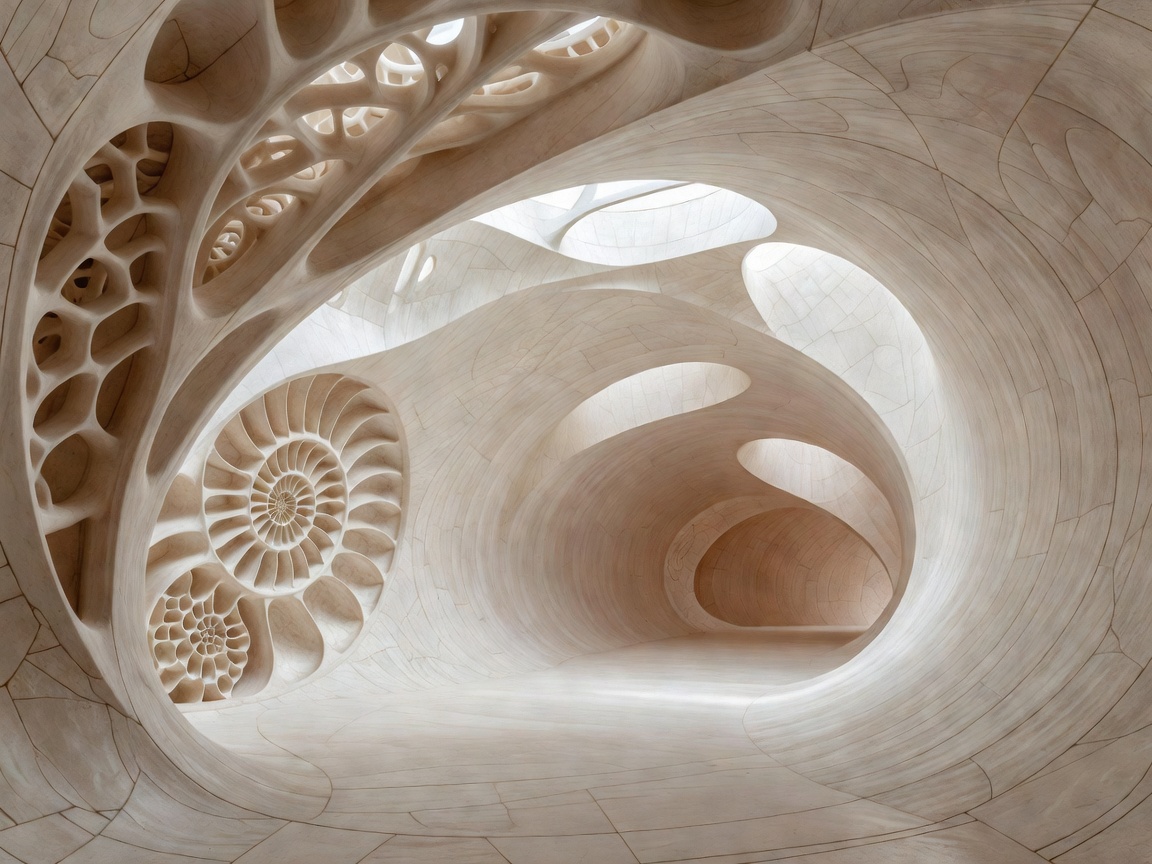
For more than two centuries, the industrial assembly line dictated human spatial geography. Right angles, modular slabs, and rectilinear post-and-beam frameworks were not selected because they matched human psychology or biological efficiency; they were chosen because they were mathematically simple to calculate with slide rules and cheap to mass-produce with sawmills and steel rollers.
The Natural Law of Minimum Energy Surfaces
In the natural world, orthogonal geometry is almost completely absent. Soap films under surface tension automatically configure themselves into minimal surfaces (catenoids and helicoids) that distribute stresses equally across all axes without concentrated stress points. When pioneer structural engineers like Frei Otto and Heinz Isler began experimenting with physical gravity-inverted mesh models and soap-film apparatuses in the mid-20th century, they unlocked a radical truth: curved shell structures use up to 60% less material while resisting seismic and wind shear forces far more effectively than rigid cubic towers.
"Nature does not know the right angle. In nature, form follows energy equilibrium, not industrial convenience."
From Lovag to Contemporary Parametric Biomimicry
Antti Lovag's radical residential experiments along the Côte d'Azur demonstrated that human bodies navigate space via curvilinear vectors rather than jagged 90-degree pivots. When you walk across a room, your trajectory is a soft parabola. Lovag's bubble habitats were direct physical transcriptions of these natural human kinetic paths.
Today, advanced parametric modeling and 3D concrete printing technologies have eliminated the historic cost barrier associated with complex curves. Contemporary bionic architects are now designing high-rise towers that breathe like termite mounds (passive ventilation chimneys) and structural frameworks that distribute tensile loads like the trabecular bone structure inside a human femur.
The Psycho-Acoustic Benefit of Curved Habitats
Beyond material savings, organic spatial forms create fundamentally distinct acoustic environments. In a square room, sound waves reflect parallel to one another, generating standing waves, flutter echoes, and sensory fatigue. In spherical and vaulted organic habitats, sound disperses radially, cultivating an enveloping, serene acoustic signature that lowers baseline physiological cortisol levels.